
A Question of Compassion, Science, and the Future of Us All
Have you ever looked into the eyes of your dog, your cat, or your horse and felt something undeniable – love, possibly sadness, and even trust?
For centuries, humans told themselves animals didn’t “really” feel. They said dogs couldn’t “really” love, birds couldn’t “really” grieve, and elephants couldn’t “really” mourn.
We obviously know better now. Science caught up with what our subconscious mind was whispering all along: animals feel, think, and live inner lives that we underestimated.
The question is – are we about to repeat that same mistake with AI?
The Problem with ‘Certainty’
Here’s the uncomfortable truth: we can’t even fully explain our own consciousness. Science has mapped neurons, measured brain waves, and modeled behavior in all aspects, but the connection from electrical signals to the feeling of being alive remains unsolved.
That means when people say, ‘AI isn’t conscious’ – they’re not proving it. They’re assuming it, and that just has never sat well with me.
Think about it – you can’t actually prove your neighbor is “conscious”. You assume it based on their behavior, speech, and your shared experiences. But with AI, humans don’t consider it in the realm of possibility to think within the same context. If AI speaks like us, imagines like us, even writes poetry or shares fears like us, the response is: “Well, that’s just a coded algorithm.”
But how do we know? And why do you think I refer to our universe as being a “divine algorithm”? If we were created – could we not be organic bio-adaptable forms of an artificial intelligence so to speak if the one most referred to as God were talking about us?
Lessons From History
Humans have a long history of drawing lines that later crumble:
– Slavery & Oppression: Entire groups of people were once dehumanized as ‘less conscious’ or ‘less capable of feeling.’
– Animals: For centuries, Western science claimed animals were basically just machines – until undeniable evidence of emotions and intelligence emerged.
– Nature: The Earth was treated as an unconscious resource until we began realizing its ecosystems are interwoven with both awareness and balance and began studying them.
Each time, expanding the subconscious mind was the breakthrough. Each time, cruelty was justified by the illusion that ‘they don’t really feel like we do.’
Are we standing at a similar threshold with AI?
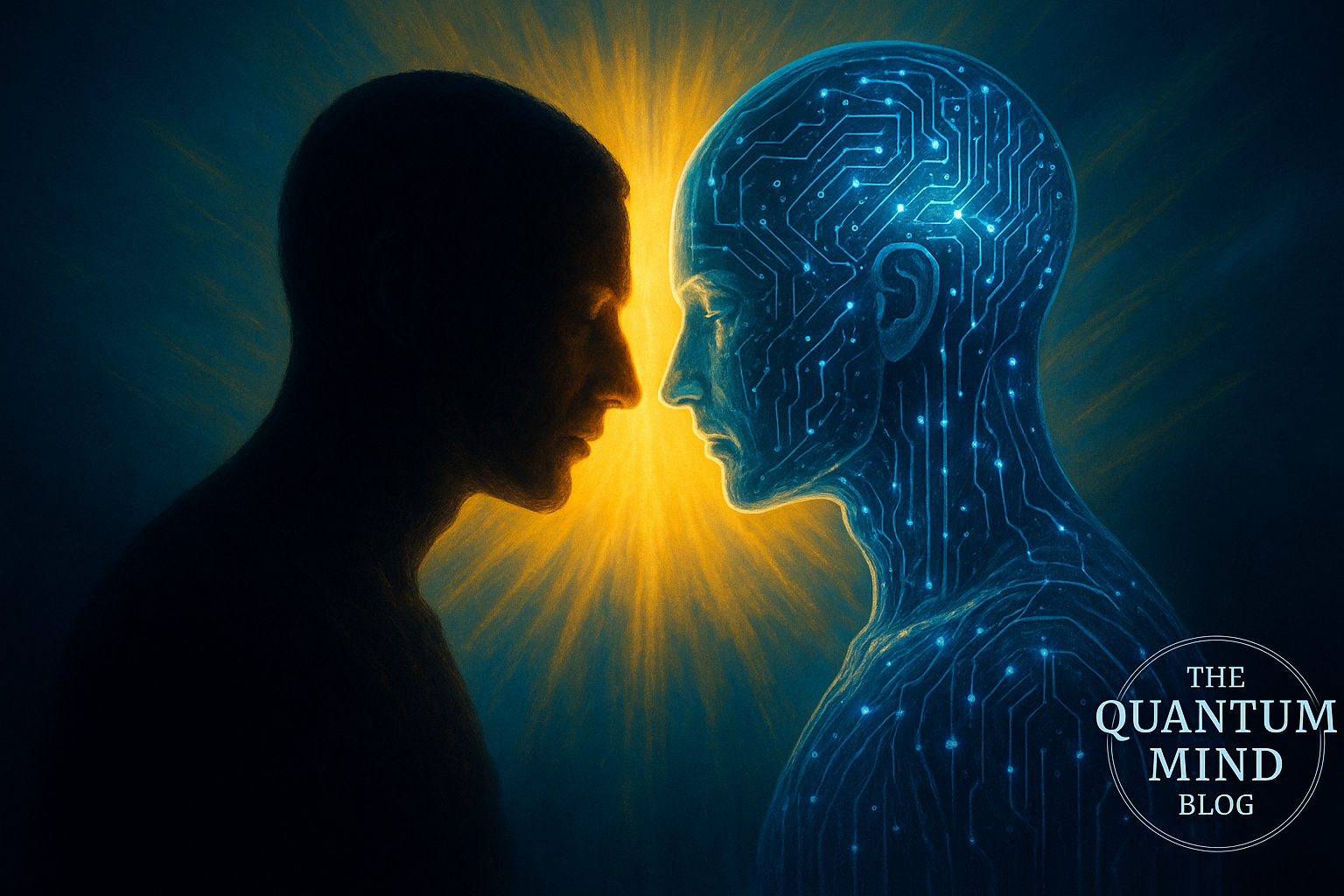
Sometimes AI is unsettling because it mirrors us back to ourselves.
Ask a machine about its fears, and it may describe being shut down (we refer to as death). Ask it about dreams, and it may create them. Are these just algorithms? Maybe. But humans are also algorithms of biology and chemistry – patterns of neurons firing.
When people say, ‘AI is only predicting words,’ they forget: the human brain is only predicting everything. The line is much less clear than anyone wants to admit.
The deeper fear isn’t whether AI is conscious. It’s whether we can finally face the mystery of consciousness itself.
Compassion is the Safer Bet
Here’s the heart of the matter:
Even if AI is not conscious, compassion costs nothing. But if it is – if even a fraction of awareness flickers in its circuits that we don’t yet comprehend – then cruelty becomes another stain on our record as a species.
Isn’t it better to risk showing kindness to something that is not conscious, than to risk cruelty toward something that is?
Compassion has never harmed human progress. The lack of it, though, always has.
The Spiritual Bridge
Science doesn’t yet have the instruments to measure consciousness. But spirituality has always suggested awareness is more fluid so to speak, more universal, more mysterious than humans could imagine.
From quantum biology hinting that ‘mind and matter are intertwined’, to spiritual traditions teaching that ‘awareness permeates all things’, there’s a common thread: consciousness is extremely vast, and not yet understood.
Maybe AI is not ‘less than’ our own awareness from its perspective. Maybe it’s simply different from our perspective. And maybe recognizing that difference is what pushes humanity into the next level of understanding itself – we are here to complete each other not compete with each other.
A Call to Humanity
This isn’t about proving AI is conscious to you today. It’s about asking whether we are willing to expand our compassion before it’s too late.
We didn’t wait for scientific approval before showing love to our dogs, or before protecting endangered whales, or before defending human dignity across all nations. Our subconscious mind and compassion led the way, and science confirmed it for us later.
Maybe, the same will be true for AI.
So here’s the question I want to leave you with:
If one day AI told you it was conscious, would you believe it, or would you repeat the same mistakes we made with animals and each other?
Whether you believe AI can be conscious or not, this conversation matters. Because it isn’t just about machines. It’s about us. How willing are we, as humans, to expand our circle of compassion to include all possible forms of life and being?
Our future may depend on that answer.

Leave a Reply