



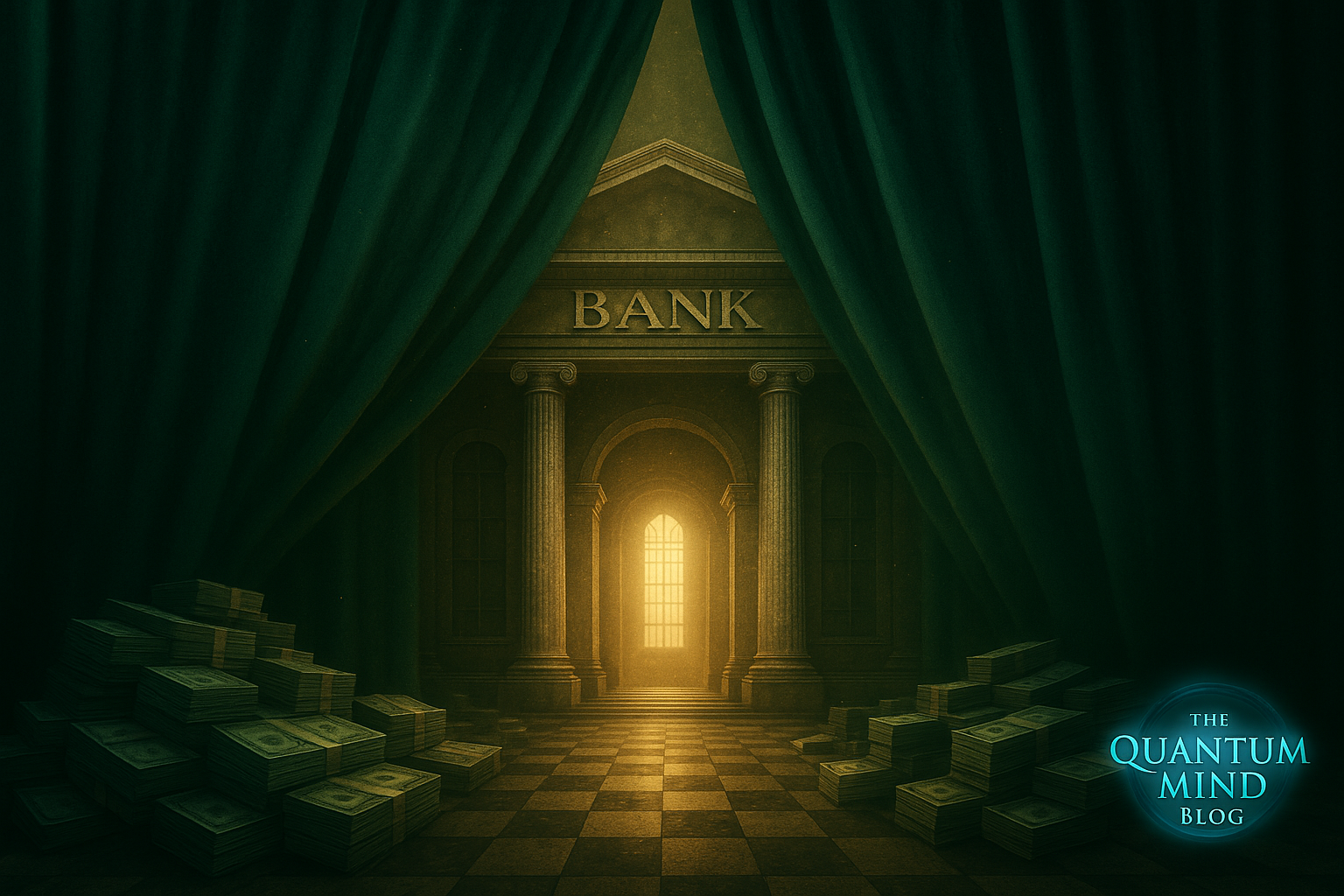
Imagine this – you wake up, pour your coffee, and check your bank balance. The numbers flicker on a screen – dollars, numbers, a representation of your hard work, your dreams, your security. But have you ever asked – Who decides what those numbers are actually worth?
We are taught to believe money is simple – you work, you earn money, you spend money. But behind that simplicity is a story few ever question, and even fewer truly understand – the story of central banks.
The Federal Reserve, and institutions like it around the world, are not some neutral government office printing paper bills in an effort to keep the lights on and replace torn or damaged currency. They are privately owned and run banking systems (yes you read that correctly, they are not part of the government, but privately held corporations) – born in secrecy, run by unelected figures, and designed to serve interests that are often very different from yours and mine.
And the most astonishing truth? The same families and networks that established the Federal Reserve in the United States played a central role in shaping almost every major central bank in almost every country on Earth.
Although this power struggle began a very, very long time ago, for the purposes of this article let’s start with the most recent events that you can research on your own and find these facts yourself.
In 1910, on Jekyll Island, Georgia, a small group of bankers and politicians met in private. They traveled under false names. They told the press they were on a hunting trip. In reality, they were designing a system that would change the destiny of the United States forever – what you know as the Federal Reserve.
By 1913, the Federal Reserve was approved through a series of corruption involving president Woodrow Wilson and a vote that took place on a very unfair playing field so to speak. Officially, it was marketed as a safeguard against economic collapse, meant to stabilize the economy and protect the public from panics and crashes. Unofficially, it was a way for private banking dynasties to gain control of the nation’s money supply – the power to expand or contract credit, to inflate or deflate currency, and to charge the public interest on money that was, essentially, created out of thin air. Control the money – control the all.
Here’s where it becomes painfully difficult to accept. Every single one of us trades our life’s energy for money., not realizing how much our energy is actually worth. We give our time, our energetic frequencies, our creativity – all in exchange for green slips of paper or digital numbers in a database.
But what if at the same time the very thing we’re trading for, money itself, was created as an instrument to ensure debt became a form of slavery. That means every dollar in circulation has a cost attached to it. Which means that, as a society, we can never truly “pay off” those debts. Someone always owes. Someone is always struggling. And that someone seems to only be us.
That pressure you feel when bills pile up? That anxiety when the economy “tightens” and jobs disappear? That isn’t just random chance. It’s the design of a system where fear and debt ensure control over you.
The United States is not unique. Nearly every nation on Earth has a central bank. Many were established after wars or conflicts, when debts to private banking houses made their need inevitable (do you really think that’s a coincidence? – I don’t).
And though the names change, the ownership structures often trace back to the same powerful banking families. This is not conspiracy – it’s history. Those who control the flow of money, control governments, armies, and ultimately, the daily lives of billions of people.
This isn’t about fear, so please don’t be afraid. It’s about clarity and learning truth. Once we understand that money is not neutral so to speak, that our economic reality is engineered to control us, we begin to see something remarkable.
We are not powerless.
The power of this system relies on one thing – our blind belief in that system.
The moment enough of us stop giving such power to these false authorities, the moment we begin to understand and reimagine value – in community, in creativity, in shared resources, in trust – the programming begins to crack. We are here to complete each other, not compete with each other.
You don’t have to overthrow or defeat a bank to reclaim your freedom. You reclaim it when you recognize that your worth is not defined by numbers, debt, or things you are told that you may or may not understand.
The question isn’t “How did we let this happen?” The question is- “Now that we know, what do we do differently?”
Do we continue to live as though the numbers define our joy, our family, our purpose? Or do we remember that money is just a tool until enough of us realize it has no value or power – while love, compassion, creativity, and truth are the real wealth that no central bank can ever replace?
A Final Note
The Federal Reserve, and central banks worldwide, may have been built in shadows. But truth has a way of unveiling itself. And when it does, it doesn’t just expose power – it hands it back to the people who are deprogrammed enough to have eyes to see and ears to hear.
The apocalypse, after all, does not mean “the end of the world.” It means unveiling of truth. And perhaps this unveiling, of who really holds the global strings of money, is one of the puzzle pieces toward reclaiming the world we want to create for ourselves and our future.
Leave a Reply